Showing posts with label Nonfiction. Show all posts

Tuesday, December 9, 2025

Book Review: The Residence: Inside the Private World of the White House by Kate Andersen Brower

The Residence: Inside the Private World of the White House

Author:
Kate Andersen Brower
Publication: Harper Paperbacks (March 8, 2016)

Description: A remarkable history with elements of both In the President’s Secret Service and The ButlerThe Residence offers an intimate account of the service staff of the White House, from the Kennedys to the Obamas.

America’s First Families are unknowable in many ways. No one has insight into their true character like the people who serve their meals and make their beds every day. In her runaway bestseller, former White House correspondent Kate Andersen Brower pulls back the curtain on the world’s most famous address. Full of stories and details by turns dramatic, humorous, and heartwarming, The Residence reveals daily life in the White House as it is really lived through the voices of the maids, butlers, cooks, florists, doormen, engineers, and others who tend to the needs of the President and First Family.

These dedicated professionals maintain the six-floor mansion’s 132 rooms, 35 bathrooms, 28 fireplaces, three elevators, and eight staircases, and prepare everything from hors d’oeuvres for intimate gatherings to meals served at elaborate state dinners. Over the course of the day, they gather in the lower level’s basement kitchen to share stories, trade secrets, forge lifelong friendships, and sometimes even fall in love.

Combining incredible first-person anecdotes from extensive interviews with scores of White House staff members—many speaking for the first time—with archival research, Kate Andersen Brower tells their story. She reveals the intimacy between the First Family and the people who serve them, as well as tension that has shaken the staff over the decades. From the housekeeper and engineer who fell in love while serving President Reagan to Jackie Kennedy’s private moment of grief with a beloved staffer after her husband’s assassination to the tumultuous days surrounding President Nixon’s resignation and President Clinton’s impeachment battle, The Residence is full of surprising and moving details that illuminate day-to-day life at the White House.

My Thoughts: Kate Andersen Brower interviewed many White House staff members to write this story about what it is like to work in the White House and interact with the First Family. She interviews people who worked in the White House from the days of the Kennedys to the Obamas. 

I was astonished to learn that the White House has 132 room, 35 bathrooms, three elevators, and eight staircases. There are six floors including a couple of mezzanines. There is a large staff of butlers, maids, cooks, florists, electricians, painters and many more people who try to keep life smooth for the First Families who live in the house. 

The staff are the ones who stay on. The First Families are renters with four or eight year leases or sometimes less. I was surprised to learn that staff positions were often held by members of the same family. I think there were five generations of Ficklins who all served at the White House. I liked the close relationships and friendships developed among those who worked at the White House. I liked reading about their dedication and pride in their jobs. 

I was amazed at the way the staff transitioned on inauguration days to make the changeover in families so smooth. I found it hard to believe that the staff could pack up one family's belongings and unpack and set up for the new family in just a matter of hours. I enjoyed the stories about how the various presidents and first ladies were as employers. 

I liked the insights into the private lives of some of the presidents, first ladies, and children who lived in the White House. 

This was a fascinating insight into the behind the scenes at a very public place. 

I bought this one March 19, 2017. You can buy your copy here.

Tuesday, July 8, 2025

Audiobook Review: The Woman Who Smashed Codes by Jason Fagone

The Woman Who Smashed Codes

Author:
Jason Fagone
Narrator: Cassandra Campbell
Publication: HarperAudio (September 26, 2017)
Length: 13 hours and 3 minutes

Description: Joining the ranks of Hidden Figures and In the Garden of Beasts, the incredible true story of the greatest codebreaking duo that ever lived, an American woman and her husband who invented the modern science of cryptology together and used it to confront the evils of their time, solving puzzles that unmasked Nazi spies and helped win World War II.

In 1912, at the height of World War I, brilliant Shakespeare expert Elizebeth Smith went to work for an eccentric tycoon on his estate outside Chicago. The tycoon had close ties to the US government, and he soon asked Elizebeth to apply her language skills to an exciting new venture: code breaking. There she met the man who would become her husband, groundbreaking cryptologist William Friedman. Though she and Friedman are in many ways the Adam and Eve of the NSA, Elizebeth's story, incredibly, has never been told.

In The Woman Who Smashed Codes, Jason Fagone chronicles the life of this extraordinary woman, who played an integral role in our nation's history for 40 years. After World War I, Smith used her talents to catch gangsters and smugglers during Prohibition, then accepted a covert mission to discover and expose Nazi spy rings that were spreading like wildfire across South America, advancing ever closer to the United States. As World War II raged, Elizabeth fought a highly classified battle of wits against Hitler's Reich, cracking multiple versions of the Enigma machine used by German spies. Meanwhile, inside an army vault in Washington, William worked furiously to break Purple, the Japanese version of Enigma - and eventually succeeded, at a terrible cost to his personal life.

Fagone unveils America's code-breaking history through the prism of Smith's life, bringing into focus the unforgettable events and colorful personalities that would help shape modern intelligence. Blending the lively pace and compelling detail that are the hallmarks of Erik Larson's best sellers with the atmosphere and intensity of The Imitation Game, The Woman Who Smashed Codes is riveting popular history at its finest.

My Thoughts: This was a fascinating biography of a woman who had a profound effect on codebreaking and who almost managed to be totally overlooked. Elizebeth Smith was a Quaker schoolteacher hired by an eccentric millionaire to work on his odd theory about William Shakespeare's plays. He believed that they were written by Francis Bacon, and the proof lay in obscure marks found in an early printing of the plays. 

The search for proof that Francis Bacon wrote Shakespeare's plays was only one of the many experiments going on at Riverbank. Also there working on genetic research was an American Jew named William S. Friedman. The two formed a friendship and then a romance and a duo that is directly responsible for the United States' codebreaking agencies. 

Elizebeth and William worked on various codes which allowed Elizebeth, working for the Coast Guard, to track down and capture rum runners and other local criminals, and William to be instrumental in breaking the codes sent by America's enemies during World War I. 

While William's work is well known and celebrated, Elizebeth's was lost in file cabinets and classified by the nascent NSA. But her role in breaking codes and locating Nazis in South America was vital to the war effort in World War II. 

There are lots of take-aways for me. I didn't form a good impression of J. Edgar Hoover and the early years of the FBI. He was quick to claim credit for other people's successes. As this quote says: "It's not quite true that history is written by the winners. It's written by the best publicists on the winning team."

I came away from this story with really impressed at how a man and woman working with pencil, paper, and brains could do so much to solve so many puzzles. I was also impressed by Elizebeth's modesty in that she didn't think what she did was all that special. 

I bought this one March 17, 2025. You can buy your copy here.

Thursday, June 26, 2025

Audiobook Review: Hidden Figures by Margot Lee Shetterly

Hidden Figures

Author:
Margot Lee Shetterly
Narrator: Robin Miles
Publication: HarperAudio (September 6, 2016)
Length: 10 hours and 47 minutes

Description: The phenomenal true story of the Black female mathematicians at NASA whose calculations helped fuel some of America's greatest achievements in space. Now a major motion picture starring Taraji P. Henson, Octavia Spencer, Janelle Monae, Kirsten Dunst, and Kevin Costner.

Before John Glenn orbited the Earth or Neil Armstrong walked on the moon, a group of dedicated female mathematicians known as "human computers" used pencils, slide rules, and adding machines to calculate the numbers that would launch rockets and astronauts into space.

Among these problem solvers were a group of exceptionally talented African American women, some of the brightest minds of their generation. Originally relegated to teaching math in the South's segregated public schools, they were called into service during the labor shortages of World War II, when America's aeronautics industry was in dire need of anyone who had the right stuff. Suddenly these overlooked math whizzes had shots at jobs worthy of their skills, and they answered Uncle Sam's call, moving to Hampton, Virginia, and the fascinating, high-energy world of the Langley Memorial Aeronautical Laboratory.

Even as Virginia's Jim Crow laws required them to be segregated from their white counterparts, the women of Langley's all-Black West Computing group helped America achieve one of the things it desired most: a decisive victory over the Soviet Union in the Cold War and complete domination of the heavens.

Starting in World War II and moving through to the Cold War, the civil rights movement, and the space race, Hidden Figures follows the interwoven accounts of Dorothy Vaughan, Mary Jackson, Katherine Johnson, and Christine Darden, four African American women who participated in some of NASA's greatest successes. It chronicles their careers over nearly three decades as they faced challenges, forged alliances, and used their intellects to change their own lives - and their country's future.

My Thoughts: HIDDEN FIGURES was a compelling listen. I was swept into the early days of NASA and the lives of some of the Black women who labored diligently and mostly in the background to bring the United States into the space age. 

Starting with World War II and the labor shortage that provided openings for bright Black women to work in the aerospace industry in Hampton, Virginia, and ending some forty years later, the accounts of the Black mathematicians who dealt with all the issues of segregation when they weren't at work was a story woven between the developments of flight and spaceflight and the gradual social changes of Black-White interactions. 

I enjoyed the author's thoughts in both the Prologue and Epilogue that illuminates her journey to learn about the times and these extraordinary women who accomplishments were mainly hidden in the background of a burgeoning industry. 

I was reminded over and over again that the adage of having to work twice as hard to get half as far was a reality for women of the time and even more so for Black women. 

I bought this one May 23, 2021. You can buy your copy here.

Wednesday, May 24, 2023

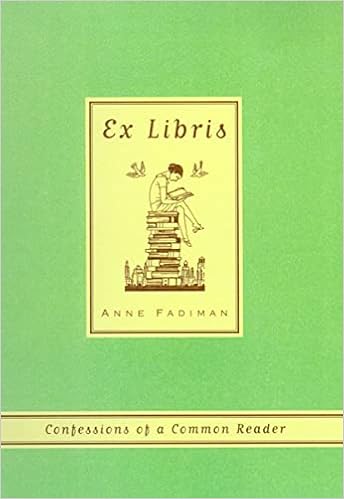
Book Review: Ex Libris: Confessions of a Common Reader by Anne Fadiman

Ex Libris: Confessions of a Common Reader

Author:
Anne Fadiman
Publication: Farrar, Straus and Giroux; 1st edition (November 25, 2000)

Description: Perfectly balanced between humor and erudition, Ex Libris establishes Anne Fadiman as one of our finest contemporary essayists.

Anne Fadiman is--by her own admission--the sort of person who learned about sex from her father's copy of Fanny Hill, whose husband buys her 19 pounds of dusty books for her birthday, and who once found herself poring over her roommate's 1974 Toyota Corolla manual because it was the only written material in the apartment that she had not read at least twice.

This witty collection of essays recounts a lifelong love affair with books and language. For Fadiman, as for many passionate readers, the books she loves have become chapters in her own life story. Writing with remarkable grace, she revives the tradition of the well-crafted personal essay, moving easily from anecdotes about Coleridge and Orwell to tales of her own pathologically literary family. As someone who played at blocks with her father's 22-volume set of Trollope ("My Ancestral Castles") and who only really considered herself married when she and her husband had merged collections ("Marrying Libraries"), she is exquisitely well equipped to expand upon the art of inscriptions, the perverse pleasures of compulsive proof-reading, the allure of long words, and the satisfactions of reading out loud. There is even a foray into pure literary gluttony--Charles Lamb liked buttered muffin crumbs between the leaves, and Fadiman knows of more than one reader who literally consumes page corners.

My Thoughts: This collection of essays illuminates Anne Fadiman's love of books and shows how books have influenced and infused her life. She covers a wide range of topics from her own curiosity about Arctic explorers especially the Victorian failures to her family's obsession with proofreading. 

Essays about merging her library and her husband's library after their marriage and about the care and treatment of books were my favorites. While she and I have different feelings about writing in books, I do share the habit of leaving books face down and sprawled open as I'm reading them. The idea that using a bookmark indicates a stop while leaving the book open and facedown indicates a pause is one I hadn't had before but do agree with. 

I don't share her feelings about used books and really don't want to find someone else's crumbs in the gutter of a book but can understand how they could appeal to some other different reader. Nor do we read the same sort of books. "Literary" and "Classics" are phrases that lead me to look for some different book while they seem to draw her in. 

All in all, I enjoyed this book. Fadiman's love for books shone clearly through each page. 

Favorite Quote:
But why do I receive catalogues devoted exclusively to salsa, equestrian gear, electric grills, extra-large clothes, extra-small clothes, tours to sites at which UFO's have landed, and resin reproductions of medieval gargoyles? Do these companies know something about me that I don't know?
I bought this one October 25, 2009. You can buy your copy here.

Wednesday, February 10, 2021

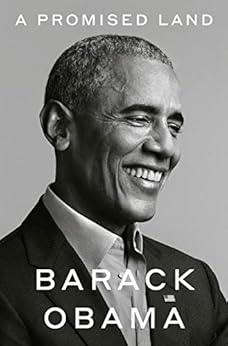
Audiobook: A Promised Land by Barack Obama

A Promised Land

Author:
Barack Obama
Narrator: Barack Obama 
Publication: Random House Audio (Nov. 17, 2020
Length: 29 hours and 10 minutes

Description: A riveting, deeply personal account of history in the making - from the president who inspired us to believe in the power of democracy.

In the stirring, highly anticipated first volume of his presidential memoirs, Barack Obama tells the story of his improbable odyssey from young man searching for his identity to leader of the free world, describing in strikingly personal detail both his political education and the landmark moments of the first term of his historic presidency - a time of dramatic transformation and turmoil.

Obama takes listeners on a compelling journey from his earliest political aspirations to the pivotal Iowa caucus victory that demonstrated the power of grassroots activism to the watershed night of November 4, 2008, when he was elected 44th president of the United States, becoming the first African American to hold the nation’s highest office.

Reflecting on the presidency, he offers a unique and thoughtful exploration of both the awesome reach and the limits of presidential power, as well as singular insights into the dynamics of US partisan politics and international diplomacy. Obama brings listeners inside the Oval Office and the White House Situation Room, and to Moscow, Cairo, Beijing, and points beyond. We are privy to his thoughts as he assembles his cabinet, wrestles with a global financial crisis, takes the measure of Vladimir Putin, overcomes seemingly insurmountable odds to secure passage of the Affordable Care Act, clashes with generals about US strategy in Afghanistan, tackles Wall Street reform, responds to the devastating Deepwater Horizon blowout, and authorizes Operation Neptune’s Spear, which leads to the death of Osama bin Laden.

A Promised Land is extraordinarily intimate and introspective - the story of one man’s bet with history, the faith of a community organizer tested on the world stage. Obama is candid about the balancing act of running for office as a Black American, bearing the expectations of a generation buoyed by messages of “hope and change”, and meeting the moral challenges of high-stakes decision-making. He is frank about the forces that opposed him at home and abroad, open about how living in the White House affected his wife and daughters, and unafraid to reveal self-doubt and disappointment. Yet he never wavers from his belief that inside the great, ongoing American experiment, progress is always possible.

This beautifully written and powerful book captures Barack Obama’s conviction that democracy is not a gift from on high but something founded on empathy and common understanding and built together, day by day. 

My Thoughts: I really enjoyed this memoir which tells about Barack Obama's growth into his role as the first Black American leader of the United States of America. 

Told by Obama with his distinctive speech patterns, I found myself deeply engaged in topics that had never crossed my mind before. I lived through this time period but never knew just how near we were to financial collapse and what extraordinary measures were taken to keep the US out of a collapse. I didn't remember the Deepwater Horizon disaster at all and was intrigued by the government's response to it.

I was intrigued about the core of people who worked with Obama to help him reach his goals. I enjoyed his viewpoint on his colleagues, political opponents and the many world leaders he worked with while in office. 

I came out of this listening experience with a deepened respect for Obama's leadership and character. I was reinforced in my belief that he was a fundamentally decent man who wanted to do more but was constrained by political realities. I was heartened by both his faith in America and his determination to make America a better place.

I enjoyed learning about his concern for the effect his political ambitions would have for his wife and daughters. 

This story is only the beginning since it ends with the location and death of Osama bin Laden. I look forward to reading further volumes of his memoir.

Because of its length, I had thought that I would listen to a chapter or so a day. However, I was quickly swept up by the events Obama described and ended up listening to his story for three days.

I bought this one. You can buy your copy here.

Tuesday, January 8, 2019

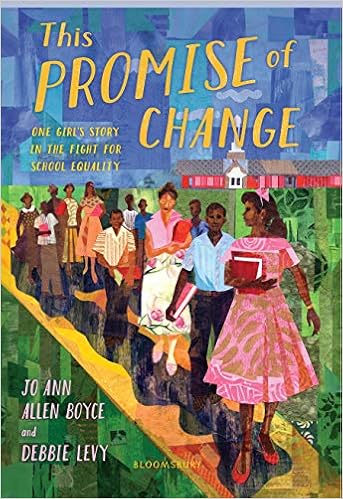
YA Book Review: This Promise of Change by Jo Ann Allen Boyce & Debbie Levy

This Promise of Change
Subtitle: One Girl's Fight for School Equality
Author: Jo Ann Allen Boyce & Debbie Levy
Publication: Bloomsbury Children's Books (January 8, 2019)

Description: In 1956, one year before federal troops escorted the Little Rock 9 into Central High School, fourteen year old Jo Ann Allen was one of twelve African-American students who broke the color barrier and integrated Clinton High School in Tennessee. At first things went smoothly for the Clinton 12, but then outside agitators interfered, pitting the townspeople against one another. Uneasiness turned into anger, and even the Clinton Twelve themselves wondered if the easier thing to do would be to go back to their old school. Jo Ann--clear-eyed, practical, tolerant, and popular among both black and white students---found herself called on as the spokesperson of the group. But what about just being a regular teen? This is the heartbreaking and relatable story of her four months thrust into the national spotlight and as a trailblazer in history. Based on original research and interviews and featuring backmatter with archival materials and notes from the authors on the co-writing process.

My Thoughts: This is the story of a little known (now) part of the Civil Rights Movement. In the fall of 1956, twelve black students entered Clinton (Tennessee) High School as the first desegregated high school in the South. Jo Ann Allen Boyce was fifteen and one of those students.

She lasted through an eventful semester with riots, Ku Klux Klan cross burnings, and national attention. She also personally dealt with harassment from other students and a strong sense of isolation and fear as she went to school.

Finally, her family gave up and moved to California both for a better education for their children and for better job opportunities for the parents too. Jo Ann was interviewed a number of times during the months she was attending school in Tennessee and after she moved to California too. She continued, and continues, to visit schools and speak about her time as one of the Clinton 12.

Her story is told in verse in quite a number of formats including forms from free verse to haiku to a variety of rhyme schemes. The use of poetry really highlighted the intense emotions of the time and the trials Jo Ann and the other Clinton 12 faced. Through it all, Jo Ann's faith and optimism shine through despite all the obstacles she faced.

The timeline of the Civil Rights Movement at the end marks the milestone of desegregation but ends with the depressing note that segregation still exists in many parts of the United States.

Favorite Quote:
John Kasper
is a stranger to Clinton,
a man from up North,
a young man
not so many years out of high school himself.

John Kasper
came to town last week
to tell white folks
that integration is un-American and un-Christian.
**************
The story of the Clinton 12 is the story of doing something hard to help people who will follow in your footsteps. It's about doing something that is deeply uncomfortable to you but that you know is right. It's about the choice between being a follower and being a leader. And it's about maintaining dignity and pride under duress. 
I received this one in exchange for an honest review from the publisher. You can buy your copy here.

Thursday, April 25, 2013

ARC Review: Battleship: A Daring Heiress, A Teenage Jockey, and America's Horse by Dorothy Ours


Battleship: A Daring Heiress, A Teenage Jockey, and America's Horse
Author: Dorothy Ours
Publication: St. Martin's Press (April 30, 2013)

Description: The moving story of a tough little horse, a gifted boy, and a woman ahead of her time.

The youngest jockey, the smallest horse, and an unconventional heiress who disliked publicizing herself.  Together, near Liverpool, England, they made a leap of faith on a spring day in 1938: overriding the jockey’s father, trusting the boy and the horse that the British nicknamed the "American pony” to handle a race course that newspapers called “Suicide Lane.”  There, Battleship might become the first American racer to win England’s monumental, century-old Grand National steeplechase.  His rider, Great Britain’s Bruce Hobbs, was only 17 years old.

Hobbs started life with an advantage: his father, Reginald, was a superb professional horseman. But Reg Hobbs also made extreme demands, putting Bruce in situations that horrified the boy’s mother and sometimes terrified the child.  Bruce had to decide just how brave he could stand to be.

On the other side of the Atlantic, the enigmatic Marion duPont grew up at the estate now known as James Madison’s Montpelier—the refuge of America’s “Father of the Constitution.”  Rejecting her chance to be a debutante, denied a corporate role because of her gender, Marion chose a pursuit where horses spoke for her.  Taking on the world’s toughest race, she would leave her film star husband, Randolph Scott, a continent away and be pulled beyond her own control.  With its reach from Lindbergh’s transatlantic flight to Cary Grant’s Hollywood, Battleship is an epic tale of testing your true worth.

My Thoughts: BATTLESHIP is filled with detail and is a fascinating look at life in the 1930s especially in the horse country of the East Coast. It tells the story of Marion duPont Somerville Scott who was a fascinating woman who routinely listed herself as a home maker on her travels but who was a horse breeder and horse trainer who, along with her brother Will, did much to set the landscape for American horse racing. 

It is also the story of a horse. Battleship is the descendant of Man o'War who made his mark by winning the Grand National at Aintree. He was an unlikely winner because of his small size and his advanced age but he was a spectacular horse.

Finally, it is the story of the jockey - Bruce Hobbs - who rode Battleship in his historic victory. We meet him as a child and watch him grow as a rider under the tutelage of his horse trainer father Reg. The picture of the riding and racing scene in England between the wars was well described.

The book is filled with detail and, because of Marion's second marriage to actor Randolph Scott, Hollywood celebrities. It is also filled with other horse loving socialites who were friends of Marion. I liked the details about her friendship with Neil Laing and Carroll Bassett.

Readers with an interest in horseracing, the 1930s, or the lives of the rich and famous will enjoy this well-researched and documented story. 

Favorite Quote:
Perhaps problems can be useful. Perhaps it was good to learn how to handle difficulties and know that you could survive the bumps. Perhaps it was good to understand, when you looked across the big sky, that you were fortunate to have come this far and also might need to be ready for something worse.
I got this eARC through St. Martin's Press Early Reviewers program. You can buy your copy here

Tuesday, April 23, 2013

Teaser Tuesday: Battleship by Dorothy Ours


Teaser Tuesdays is a weekly bookish meme, hosted by MizB of Should Be Reading. Anyone can play along! Just do the following:
  • Grab your current read
  • Open to a random page
  • Share two (2) “teaser” sentences from somewhere on that page
  • BE CAREFUL NOT TO INCLUDE SPOILERS! (make sure that what you share doesn’t give too much away! You don’t want to ruin the book for others!)
Share the title and author, too, so that other TT participants can add the book to their TBR Lists if they like your teasers!

This week my teaser comes from Battleship: A Daring Heiress, A Teenage Jockey, and America's Horse by Dorothy Ours. I got this eARC from St. Martin's Press Early Reviewer program. I don't usually read nonfiction but this one sounded very interesting. Here is the description:

The moving story of a tough little horse, a gifted boy, and a woman ahead of her time. 

The youngest jockey, the smallest horse, and an unconventional heiress who disliked publicizing herself.  Together, near Liverpool, England, they made a leap of faith on a spring day in 1938: overriding the jockey’s father, trusting the boy and the horse that the British nicknamed the "American pony” to handle a race course that newspapers called “Suicide Lane.”  There, Battleship might become the first American racer to win England’s monumental, century-old Grand National steeplechase.  His rider, Great Britain’s Bruce Hobbs, was only 17 years old. 

Hobbs started life with an advantage: his father, Reginald, was a superb professional horseman. But Reg Hobbs also made extreme demands, putting Bruce in situations that horrified the boy’s mother and sometimes terrified the child.  Bruce had to decide just how brave he could stand to be. 

On the other side of the Atlantic, the enigmatic Marion duPont grew up at the estate now known as James Madison’s Montpelier—the refuge of America’s “Father of the Constitution.”  Rejecting her chance to be a debutante, denied a corporate role because of her gender, Marion chose a pursuit where horses spoke for her.  Taking on the world’s toughest race, she would leave her film star husband, Randolph Scott, a continent away and be pulled beyond her own control.  With its reach from Lindbergh’s transatlantic flight to Cary Grant’s Hollywood, Battleship is an epic tale of testing your true worth.
Teaser:
A hoof touches earth; a nose jolts toward the turf. A tremor races through two bodies, with all of the possibilities that burst open whenever I becomes we.
What do you think? Will you be adding this April 30 release to your stack?

Sunday, December 19, 2010

In My Mailbox (Dec. 19, 2010)

The weekly In My Mailbox post is hosted by Kristi at The Story Siren. It is fun to see what everyone else gets in their mailboxes, shopping bags, and library visits.
 
I guarantee that your TBR pile will grow when you see all the wonderful books everyone gets. You will discover lots of great blogs and lots of books that you won't be able to live without.

Kristi is taking a few weeks off from hosting the IMM meme. She expects to resume it sometime after the first of the year.

Here is what I got this week.
Eliza's Daughter by Joan Aiken is one of the many books written in homage to the works of Jane Austen. This week being Jane's 300+ birthday, a lot of them were being offered for free for my Kindle. I am not a big Jane Austen fan, in fact I have never managed to finish one, but I am a fan of Joan Aiken.

The Scientists by John Gribbin is one of the rare nonfiction books that I buy. I have a certain fascination with the history of science that I have developed since I have been teaching it to my fifth grade students. This one sounded like it was enough about the people rather than the science that I would enjoy it.
These three books were also free for my Kindle. They are all in the erotic romance category.

These will be part of my 'read someday' collection. I need to have a bunch of free time and be in the right mood for these.

That's what I got. What came in your mailbox this week?


Thursday, July 15, 2010

Review: A Short History of Nearly Everything by Bill Bryson

A Short History of Nearly Everything
Author: Bill Bryson
Publication: Broadway; First Edition edition (September 14, 2004)


Description: One of the world's most beloved and bestselling writers takes his ultimate journey -- into the most intriguing and intractable questions that science seeks to answer.


In A Walk in the Woods, Bill Bryson trekked the Appalachian Trail -- well, most of it. In In A Sunburned Country, he confronted some of the most lethal wildlife Australia has to offer. Now, in his biggest book, he confronts his greatest challenge: to understand -- and, if possible, answer -- the oldest, biggest questions we have posed about the universe and ourselves. Taking as territory everything from the Big Bang to the rise of civilization, Bryson seeks to understand how we got from there being nothing at all to there being us. To that end, he has attached himself to a host of the world's most advanced (and often obsessed) archaeologists, anthropologists, and mathematicians, travelling to their offices, laboratories, and field camps. He has read (or tried to read) their books, pestered them with questions, apprenticed himself to their powerful minds. A Short History of Nearly Everything is the record of this quest, and it is a sometimes profound, sometimes funny, and always supremely clear and entertaining adventure in the realms of human knowledge, as only Bill Bryson can render it. Science has never been more involving or entertaining.


My Thoughts: This was a fascinating look at the the development of science. It is amazing to me how little we know about the world we live on and how much is yet to be discovered. I found the personal details about some of the scientists my students study to be very interesting. It seems to me that every page of this book has something that is startling or amazing or frightening. And every page had something that was quotable.


I learned so many new things while reading this book. I do recommend reading it, as I did, one chapter at a time. There is so much discussed from the age of the universe to the tiniest microorganisms that I needed time to stop and process the information before moving on. And some of it, though explained quite clearly, is still baffling and awe-inspiring.


The prose style was clear and engaging. The descriptions were something any non-scientist could at least begin to understand. Some of the ideas are so amazing that I can't begin to imagine how they were developed in the first place. I found it interesting that so often someone would have an idea that was correct but nothing would be done with the idea until some time later. An idea needed to come at the correct time and in the correct place.


I recommend this book to anyone who is curious about our world and universe. I can see that this would be a very useful book to writers of science fiction. In fact, when I read about mitochondria, I thought of the works of Madeleine L'Engle. 


Favorite Quote:
It is fairly amazing to reflect that at the beginning of the twentieth century, and for some years beyond. the best scientific minds in the world couldn't actually tell you where babies came from.


And these, you may recall, were men who thought science was nearly at an end.
Challenges: RYOB Reading Challenge

Tuesday, June 29, 2010

Teaser Tuesday: A Short History of Nearly Everything by Bill Bryson

 
Teaser Tuesdays is a weekly bookish meme, hosted by MizB of Should Be Reading. Anyone can play along! Just do the following:
  • Grab your current read
  • Open to a random page
  • Share two (2) “teaser” sentences from somewhere on that page
  • BE CAREFUL NOT TO INCLUDE SPOILERS! (make sure that what you share doesn’t give too much away! You don’t want to ruin the book for others!)
  • Share the title and author, too, so that other TT participants can add the book to their TBR Lists if they like your teasers!

Bill Bryson's A Short History of Nearly Everything will be closest to hand for a while. I am trying to read a chapter a day of this nonfiction book. 

America, Buffon wrote in his vast and much-esteemed Histoire Naturelle, was a land where the water was stagnant, the soil unproductive, and the animals without size or vigor, their constitutions weakened by the "noxious vapors" that rose from its rotting swamps and sunless forests. In such an environment even the native Indians lacked virility. "They have no beard or body hair," Buffon sagely confided, "and no ardor for the female." Their reproductive organs were "small and feeble." 
I am enjoying learning about how scientific ideas came about and how they changed over time. 

Friday, June 25, 2010

A Short History of Nearly Everything by Bill Bryson


I was reading a post on MySpace by Lois McMaster Bujold the other day where she was talking about some of the books she has been reading. Now, I am a huge fan of anything Lois writes and, if she recommends a book, I am at least going to give it a try. One of the books she talked about was A Short History of Nearly Everything by Bill Bryson. 


Oddly enough, I am charged with teaching my fifth grade students something about famous scientists as part of their media classes, and so this geography major and history minor librarian needs to know something about the history of science. This book sounded like it would kill two birds with one stone. I would add to my knowledge of the history of science and I would see one of the books that one of my favorite author's was reading. 

I read almost no nonfiction by choice because I usually find the writing sort of boring. Bill Bryson is a very engaging writer and I love his style. So I decided to read a chapter a day of this book. I am going to share just one thought-provoking quote from each chapter and do this post every once in a while so that anyone interested can get a brief taste of the book. 

Introduction

There seemed to be a mystifying universal conspiracy among textbook authors to make certain the material they dealt with never strayed to near the realm of the mildly interesting and was always at at least a long-distance phone call from the frankly interesting.
How to Build a Universe

Incidentally, disturbance from cosmic background radiation is something we have all experienced. Tune your television to any channel it doesn't receive, and about 1 percent of the dancing static you see is accounted for by this ancient remnant of the Big Bang. The next time you complain that there is nothing on, remember that you can always watch the birth of the universe.
Welcome to the Solar System

Of course, it is possible that alien beings travel billions of miles to amuse themselves planting crop circles in Wiltshire or frightening the daylights out of some poor guy in a pickup truck on a lonely road in Arizona (they must have teenagers, after all), but it does seem unlikely.
That is it for today. I hope you found some to amuse you or to ponder here. Stay tuned for our next installment.....

Lois McMaster Bujold on MySpace
Lois's website
Bill Bryson's website